



The cryptocurrency market has erased roughly $730 billion from its valuation over the past 100 days as Bitcoin price drops over 47% from its all-time high, per a report.
What began as a seemingly routine pullback during an extended bullish cycle has evolved into one of the sharpest drawdowns in crypto history. During this period, both Bitcoin and altcoins have faced sustained selling pressure, reflecting a prolonged phase of weak price action.
Market participants have gradually reduced exposure, liquidity has thinned, and sentiment has shifted decisively toward caution.
Bitcoin Bears the Brunt of Market Outflows
Bitcoin has declined 47% from its October 2025 all-time high of $126,200 to approximately $66,900 at the time of writing. As the leading crypto asset and a bellwether for the broader ecosystem, Bitcoin’s decline has amplified pressure across the market.
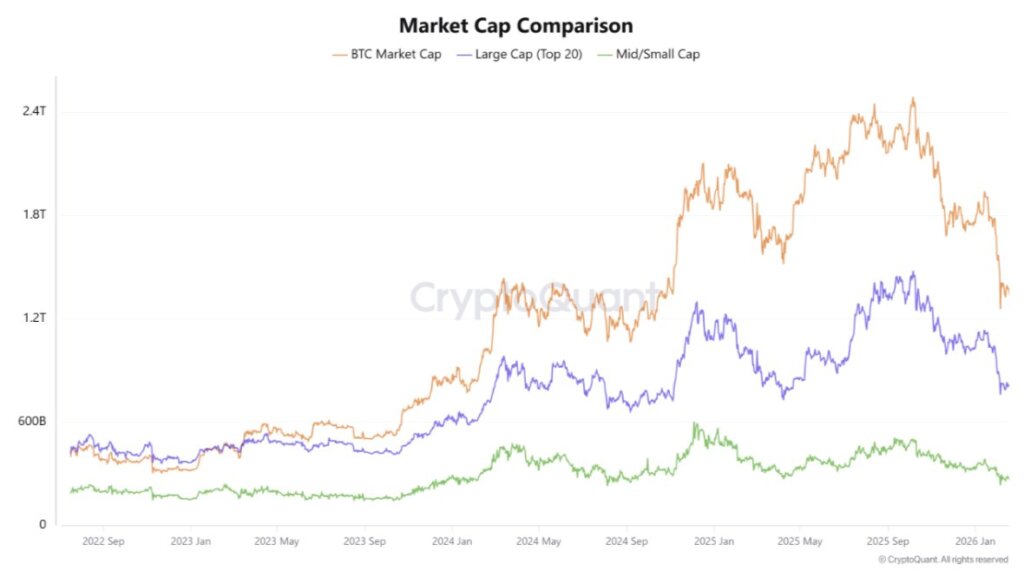
Its market capitalization has fallen from $1.69 trillion to nearly $1.35 trillion during the correction, translating to a loss of over $340 billion. At the time of the writing, BTC’s valuation has slipped further to around $1.33 trillion, underscoring the continued weakness. However, Bitcoin’s contraction represents only part of the broader market retreat.
Altcoins and Smaller Caps See Deeper Contraction
The top 20 cryptocurrencies by market capitalization, excluding Bitcoin and stablecoins, declined from $1.07 trillion in early December to $810.65 billion. This marks a 15.17% drop, wiping out nearly $260 billion in value.Mid- and small-cap altcoins experienced even sharper proportional losses.
Their combined market capitalization fell from $390.3 billion to $263.63 billion, representing a 20% correction totaling approximately $122.75 billion. The synchronized decline across asset tiers suggests that investors are not simply rotating capital within the crypto sector.
Instead, funds appear to be exiting the market entirely. Even top-tier altcoins, often viewed as relatively strong during bear market cycles, have moved in tandem with Bitcoin.
Read also: Bitcoin Hits Two-Month High, Triggers Nearly $700M in Liquidations
Macro Pressure and Fading Confidence
Broad-based capital outflows typically reflect wider macroeconomic uncertainty. When liquidity exits the entire crypto ecosystem at once, it often signals declining risk appetite rather than isolated project weakness.
The result has been a sustained correction marked by lower trading volumes, cautious positioning, and heightened fear across the market. What initially appeared to be a temporary cooling period has extended into a deeper structural retracement.
Per the report, GugaOnChain urges long-term investors to remain focused on forward-looking indicators rather than short-term sentiment swings. What we are witnessing is an unprecedented short-term capital flight, deepening the contraction of the crypto economy,” he wrote.
Historically, extended drawdowns of this magnitude have preceded stabilization phases and eventual recoveries. Key metrics to monitor include Bitcoin’s cost basis distribution, capital flow trends, and on-chain behavior patterns, which can provide clearer signals about market positioning.
Notably, some on-chain indicators are beginning to suggest that Bitcoin may be approaching a potential bottoming zone. Particularly, an earlier CryptoQuant report noted that Bitcoin must revisit the $55K realized price before any rally.
As retail sells and futures deleveraging rises, one top analyst submitted that Bitcoin risks deeper correction to $50,000. At press time, BTC is trading at $68,233, down 2.1% in the past seven days m in