



Shiba Inu (SHIB) is once again under heavy selling pressure as technical indicators flash bearish signals and liquidation activity surges across the broader crypto market.
The second-largest meme token by market cap has struggled to maintain upward momentum following a brief rebound earlier this month. Fresh weakness on lower timeframes, combined with a sharp spike in forced liquidations, is reinforcing concerns that SHIB may face additional downside in the near term.
At the time of writing, Shiba Inu is trading near $0.00000620, hovering just above a key support zone that has held through previous market downturns.
Death Cross Signals Fading Short-Term Momentum
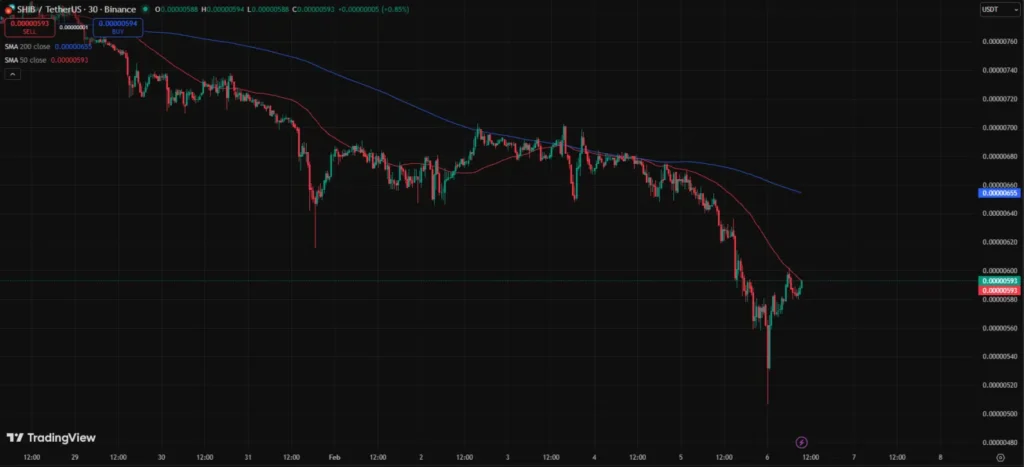
On the 30-minute chart, Shiba Inu has confirmed a classic death cross, where the 50-period moving average has crossed below the 200-period moving average. This pattern is widely viewed as a bearish signal, highlighting weakening short-term momentum and often appearing during sustained corrective phases.
While lower-timeframe death crosses can sometimes produce false signals, their reliability increases when they are in line with broader market weakness. Earlier on February 3, SHIB briefly displayed bullish momentum when its 50-period moving average moved above the 200-period moving average, forming a short-lived golden cross.
However, that signal quickly failed as selling pressure returned, leading to the current death cross formation. Notably, the failed golden cross developed while SHIB continued printing lower highs, and yesterday’s move produced lower lows, further reinforcing a bearish market structure.
From a technical perspective, SHIB remains below key moving averages, and buyers have yet to demonstrate sustained control. Until price can reclaim and hold above these levels, downside risk remains elevated.
Liquidations Rise as Market Stress Builds
Derivatives data shows that forced position closures intensified during the recent downturn. Across the entire crypto market, more than $2.59 billion in liquidations occurred within the past 24 hours.
Long positions accounted for the majority of the damage, with approximately $2.14 billion wiped out, compared with $455.7 million in short liquidations. This imbalance indicates that bullish traders were heavily positioned before the drop and were forced to exit as prices fell, adding further selling pressure.
While Shiba Inu is not among the largest contributors to total liquidations, the token still recorded notable losses. Roughly $1.07 million in SHIB positions were liquidated over the same period, with bulls accounting for around $982,360 of that figure.
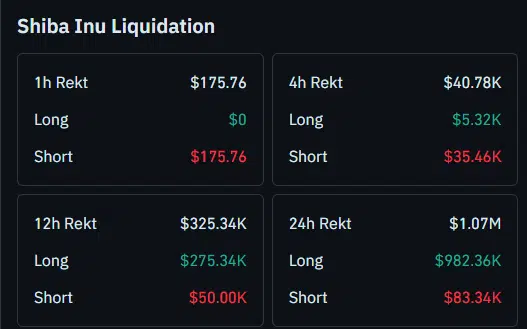
Such liquidation-driven selling often amplifies price declines, as automated systems close positions regardless of market conditions.
Key Support Holds, But Structure Remains Bearish
Despite the negative signals, SHIB is currently trading near an important historical support level around $0.0000051. Notably, Shiba Inu has never broken below this support zone, highlighting its significance.
The current bounce may represent buyers stepping in to defend this area. However, recent price action shows a pattern of temporary rebounds followed by lower highs, which typically precedes further downside moves.
Until SHIB can break this sequence and establish higher highs, any upside is likely to be viewed as corrective rather than trend-reversing.
Broader market conditions also remain a key factor. With Bitcoin and major altcoins experiencing volatility and heavy liquidation activity, memecoins like SHIB tend to underperform during periods of risk-off sentiment. In the meantime, sellers continue to control the short-term trend.
What’s Next for the SHIB Price?
Shiba Inu’s confirmed death cross, combined with rising Bitcoin liquidations and a fragile market environment, points to continued downside risk. Trading at $69,000 at the time of writing, top analysts expect the BTC price to decline to $50,000 before any major pull back.
While a short-term bounce from key support is encouraging, SHIB must reclaim critical moving averages and demonstrate sustained buying strength before any meaningful trend reversal can occur. Until then, caution remains warranted as bearish momentum continues to dominate.