



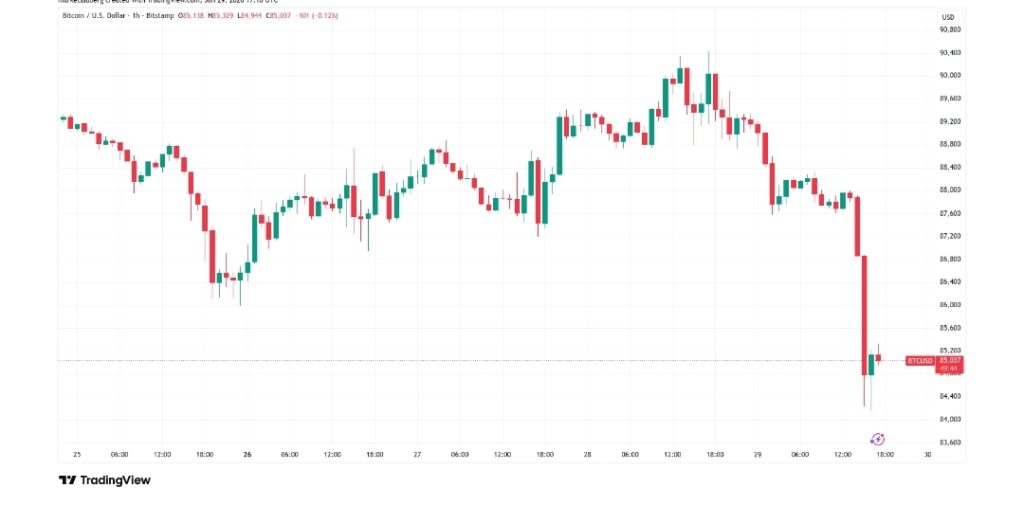
Bitcoin has continued to extend losses, falling to its lowest level in two months as turbulence spread across global financial markets.
The sharp decline came alongside sudden reversals in gold and silver, signaling a broader risk-off move that caught traders across asset classes off guard.
Bitcoin dropped as low as $81,315 across crypto exchanges per Coingecko data, marking a nearly 6% intraday decline. The bearish development dragged the asset below several key technical levels and erased much of the progress made earlier this year. Altcoins followed a similar trajectory, compounding pressure across the digital asset market.
The synchronized sell-off across crypto, equities, and precious metals suggests that the latest downturn is being driven less by crypto-specific developments and more by growing unease around global financial stability.
Bitcoin Breaks Key Support as Liquidations Surge
Bitcoin’s slide accelerated after the price failed to hold above the 2026 yearly open and nearby moving averages. These zones had previously acted as short-term support but were overwhelmed by a wave of aggressive selling.
As price slipped, forced liquidations swept through derivatives markets. Data from major tracking platforms indicates that more than $500 million worth of leveraged crypto positions have been liquidated since Thursday, intensifying downward momentum.
This type of cascade is common during periods of high leverage, where falling prices trigger automatic position closures that push prices even lower. Top crypto analysts note that such liquidation-driven moves often exaggerate short-term price action.
Despite the sharp decline, some traders view the flush as a potential reset rather than the start of a prolonged collapse. Crypto trader and analyst Michaël van de Poppe said the panic move across metals and crypto reflects temporary stress rather than structural weakness, adding that Bitcoin’s moment to outperform may still lie ahead once markets stabilize.
He wrote: “Wild markets today as Gold and Silver erase trillions in minutes. Yes, BTC goes down during that panic flush, and we’ll probably see some lower levels. <$84,000 is where things get interesting for liquidity. The chances of Gold and Silver calming down have increased. Time for Bitcoin to shine is coming.”
Precious Metals Shock Traders With Abrupt Reversal
Gold and silver, which had been posting historic gains in the past weeks, experienced a sudden and violent pullback. Gold briefly touched $5,600 before plunging by roughly $400 in just 30 minutes on Thursday, erasing a massive amount of market value.
The speed and scale of the reversal surprised market participants, particularly given gold’s reputation as a relatively stable safe-haven asset. Nic Puckrin, CEO of crypto education platform Coin Bureau, described the price action as highly “insane”, warning that such moves in precious metals often point to deeper stress within the financial system.
According to Puckrin, rising demand for gold and silver in recent weeks suggests growing concern about the long-term strength of fiat currencies, particularly the U.S. dollar. People are worried “because debt dynamics don’t work at current rates,” he submitted.
“The U.S. needs lower rates to service its debt. Lower rates usually mean a weaker dollar. A weaker dollar pushes global players to diversify reserves away from USD assets,” Puckrin added.
He further suggested that central banks and large investors may be positioning defensively ahead of potential turbulence. In his words: “Rate cuts are coming. Fiscal spending isn’t slowing. Global cooperation is visibly breaking down. Countries have learned that reserves can be frozen. They are prepositioning.”
In this context, Bitcoin’s drop appears to be part of a wider de-risking event rather than an isolated crypto failure.
Monthly Close Could Define Bitcoin’s Near-Term Trend
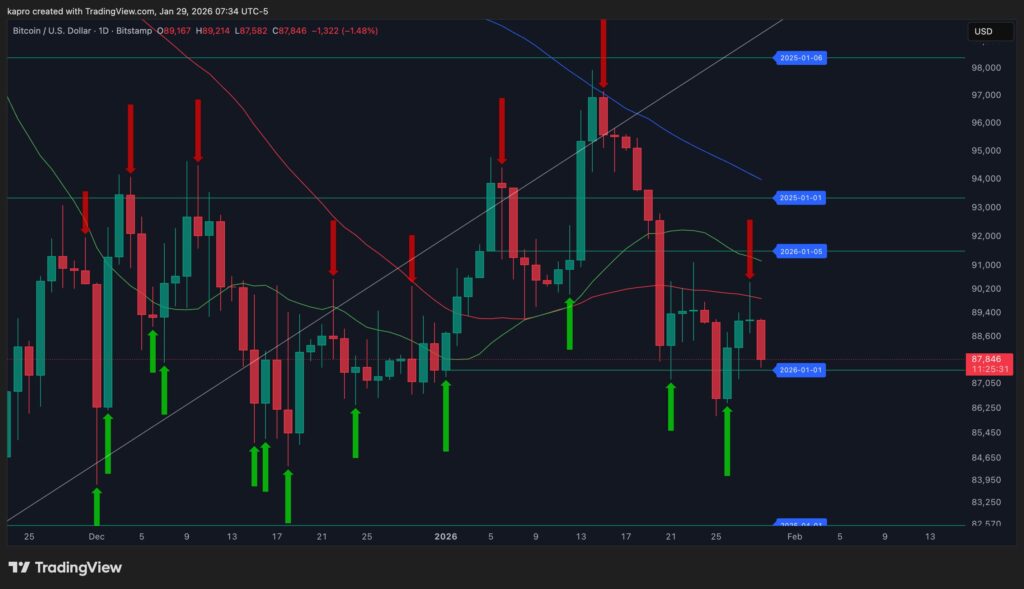
With January’s monthly candle approaching its close, traders are paying close attention to whether Bitcoin can reclaim key levels. Keith Alan, co-founder of trading analytics platform Material Indicators, emphasized that the yearly open of around $87,500 represents a crucial threshold.
He noted that “BTC is once again testing support at what I consider to be the most important level on the chart. The monthly candle close rapidly coming into focus makes this an inflection point for the trend.”
According to him, a monthly close above this zone could restore bullish confidence and support a potential recovery. However, failure to regain that level may leave BTC vulnerable to a deeper corrective phase.
Alan further noted that a sustained close below the yearly open would tilt market structure toward bearish conditions, increasing the probability of further downside in the weeks ahead.
Adding to uncertainty, Alan earlier highlighted unusual order-book behaviour from large entities that appeared to suppress upward price movement, though the identity and intent behind these actions remain unclear.
Macro Factors Continues to Shape Crypto Price Action
The latest market turbulence shows how tightly crypto has become linked to global macroeconomic forces. Concerns around sovereign debt, currency stability, and broader financial system health are increasingly influencing Bitcoin’s short-term direction.
While long-term investors often frame BTC as a hedge against monetary instability, short-term price action still reacts strongly to liquidity shifts and investor sentiment.
In the meantime, Bitcoin faces a challenging environment as traders assess whether the current sell-off represents exhaustion or the early stages of a broader downturn. However, much will depend on how price behaves around key technical levels and whether global markets regain composure. Until then, volatility is likely to remain elevated.
At the time of writing, BTC is trading at $82,815, down by 5.8% in the past 24 hours.