

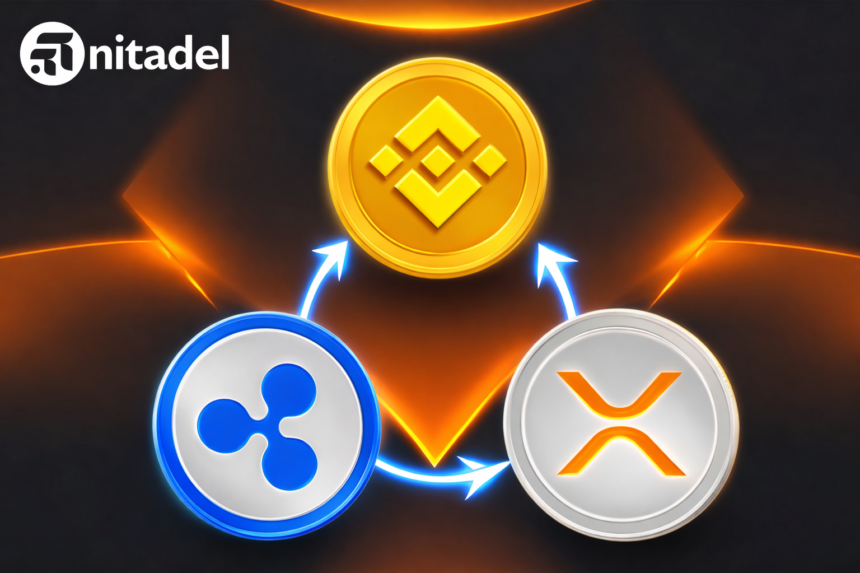
Binance has completed the integration of Ripple USD (RLUSD) on the XRP Ledger (XRPL), advancing Ripple’s stablecoin strategy.
The positive development strengthens Ripple’s broader strategy of positioning RLUSD alongside XRP within a compliance-focused financial ecosystem.
In a Thursday update, Binance confirmed that RLUSD deposits via the XRP Ledger are now live, with withdrawals set to begin once sufficient liquidity develops. The announcement completes the technical rollout of RLUSD on XRPL on the world’s largest crypto exchange by trading volume.
While the update appears procedural, its strategic implications are significant. The integration directly connects the Ripple-backed stablecoin to the native XRP Ledger environment within Binance’s liquidity ecosystem.
RLUSD on XRP Ledger
When Binance listed RLUSD in January 2025, support was limited to the Ethereum network. Initial trading pairs included RLUSD/USDT and XRP/RLUSD, giving the asset access to broader stablecoin liquidity and XRP-native markets.
The latest update changes that structure as the integration of RLUSD on XRP Ledger reduces reliance on Ethereum infrastructure. It also reinforces the XRPL as a primary settlement layer within Ripple’s stablecoin architecture.
Ripple leadership has consistently framed RLUSD as complementary to XRP rather than a competitor. During the initial Binance listing, Ripple CEO Brad Garlinghouse described the development as “eXtRemely Positive” in a X post, emphasizing XRP.
The completion of XRPL integration re-echoes that positioning and puts RLUSD more closely with XRP-based liquidity flows.
Read also: Wall Street Giant Goldman Sachs Discloses $153 Million XRP Position
Why Binance’s RLUSD Integration Matters
The strategic importance of Binance integrating RLUSD on XRPL centres on infrastructure alignment. A stablecoin operating natively on XRPL within Binance’s deep liquidity pools could increase on-chain transaction activity on the XRP Ledger. It could also strengthen liquidity in XRP-denominated trading pairs and improve settlement efficiency for cross-border and enterprise use cases.
Because RLUSD is designed as a regulated, enterprise-grade stablecoin, its expansion across major exchanges suggests growing institutional comfort with Ripple’s dual-asset model. Specifically, XRP as a bridge asset and RLUSD as a stable-value settlement instrument.
Ripple executives publicly welcomed the integration. Reece Merrick, Ripple’s Managing Director for the Middle East and Africa, described the development as a milestone in RLUSD’s exchange expansion.
Prominent XRP market analyst EGRAG also characterized the update as strategically meaningful, reflecting broader market interest in how RLUSD and XRP may interact within Binance’s ecosystem.
Moreover, the integration of RLUSD on XRPL on Binance would allow more seamless interaction between XRP liquidity and RLUSD settlement flows. If trading activity and transfers scale meaningfully, this alignment could create structural demand drivers within the XRP Ledger ecosystem.
For XRP proponents, the integration signals more than incremental exchange support. It represents deeper integration between Ripple’s stablecoin strategy and the blockchain infrastructure underpinning XRP.
As RLUSD expands across networks and trading platforms, the relationship between stablecoin liquidity and XRP utility will likely become one of the factors that could drive XRP price upward. Trading for $1.42 at the time of writing, one analyst says the crypto asset still faces downside risk towards $0.5.